End-of-Life Signs for Commercial Flat Roofs in Calgary: When It’s Time to Replace
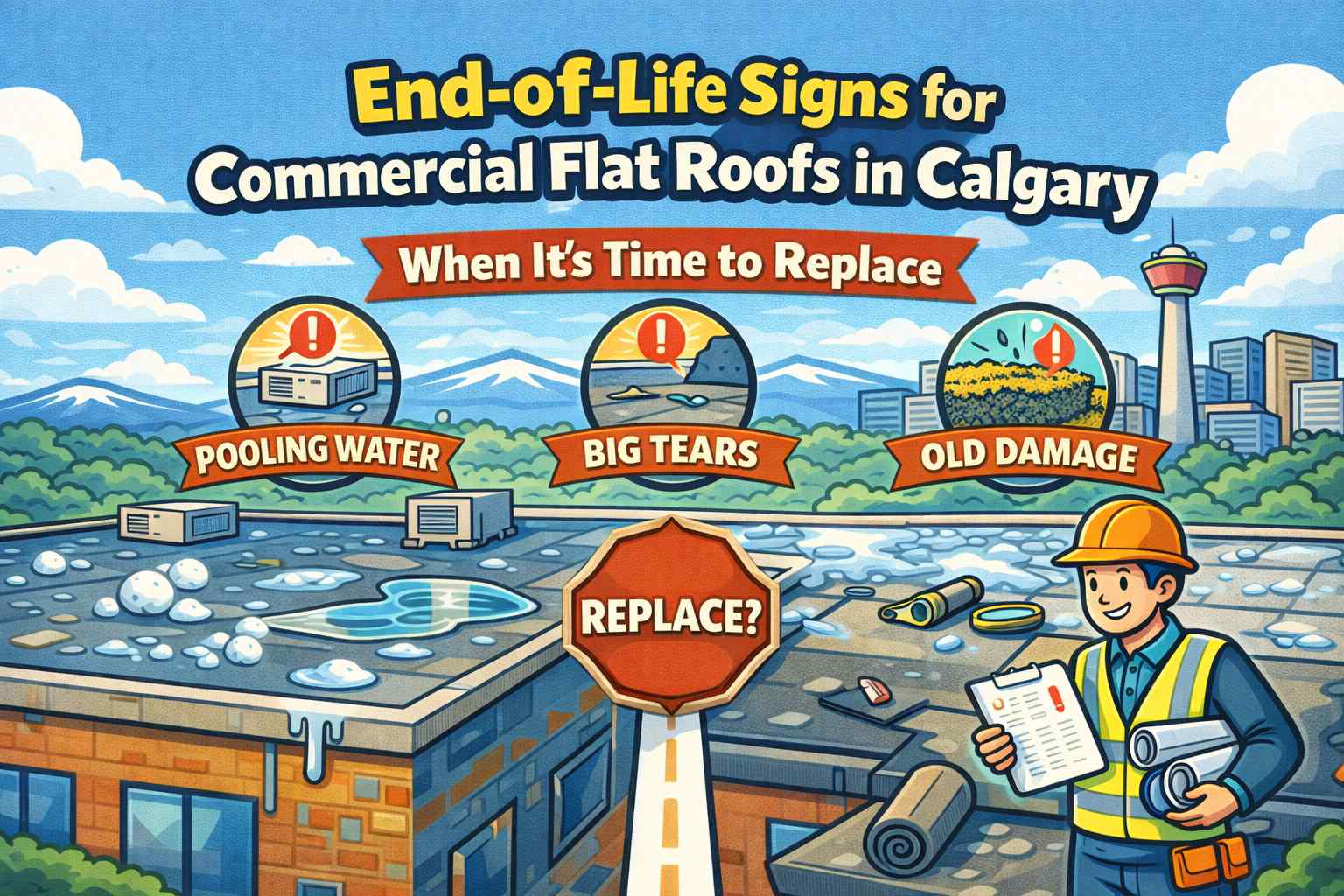
Every commercial flat roof in Calgary has a lifespan. Maintenance, coatings, and repairs can stretch that life for years, but eventually, the system reaches a point where it’s no longer smart—or safe—to keep patching. The challenge for property and facility managers is knowing when that line has been crossed.
Replace too early and you burn capital unnecessarily. Replace too late and you risk leaks, tenant complaints, interior damage, and emergency call-outs in the middle of a storm.
This guide walks through practical end-of-life signs for commercial flat roofs in Calgary and how to decide when it’s time to move from repair and restoration to a full replacement. It also shows how this decision ties into inspections, drainage fixes, coatings, emergency response, and long-term asset planning across your portfolio.
Calgary’s climate accelerates roof ageing:
Some of these pressures are covered in detail in “How Calgary’s Weather (Hail, Chinooks & Freeze–Thaw) Impacts Flat Roof Systems” on the CMP Roofing blog at Blog.
Because weather loads are so intense, once a roof starts to fail, it tends to deteriorate quickly. Recognizing end-of-life signs early lets you:
For replacement planning and budgeting, pair this article with “Commercial Flat Roof Replacement in Calgary: Costs, Options & Timelines for Property Managers” at Blog.
A leak or two over the life of a flat roof is normal. Chronic, recurring leaks are not.
Red flags include:
This often means:
If your leak log shows the same building or roof section generating work orders season after season, you’re likely moving into end-of-life territory.
For what to do in the first 24 hours of an active leak, see “Calgary Commercial Roof Leak Repair: What Facility Managers Should Do in the First 24 Hours” and “Emergency Roof Leak Repair in Calgary: 24/7 Process, Response Times & What It Costs” at Blog.
The health of a flat roof isn’t just about the surface—it’s also about what’s happening underneath the membrane.
During a professional inspection, CMP Roofing may recommend core samples or non-destructive moisture testing. Persistent moisture below the membrane is one of the clearest end-of-life indicators.
Warning signs:
Once insulation is widely saturated:
In roofs with significant saturation, it’s usually time to move past patching and look seriously at full tear-off and replacement. For how moisture findings guide the decision between coatings, overlays, and tear-off, see “Commercial Roof Replacement vs Restoration in Calgary: Coatings, Overlays or Tear-Off?” at Blog.
Ponding water is common on aging flat roofs—but when it becomes persistent and widespread, it’s an end-of-life sign rather than just a maintenance issue.
Indicators that drainage has moved beyond simple cleaning:
In these cases, the problem is often baked into the assembly:
While some ponding issues can be solved with tapered insulation and targeted rework, others require a broader re-slope and replacement approach.
For a deeper look at how drainage and freeze–thaw interact—and when permanent fixes are needed—see “Flat Roof Drainage Problems in Calgary: Ponding, Freeze–Thaw Damage & Permanent Fixes” at Blog.
Calgary’s hail and UV exposure can age flat roofs long before their “paper” lifespan.
End-of-life surface clues include:
While localized hail damage can sometimes be repaired or addressed with coatings, broad, deep damage across the roof usually signals the system is at or near the end of its useful life.
For storm-specific assessment and insurance coordination, see “Hail Damage to Commercial Roofs in Calgary: Inspection, Insurance Claims & Repair Options” at Blog.
On single-ply and even some multi-ply systems, movement becomes more pronounced with age.
Common end-of-life detail failures:
In Calgary, Chinooks and freeze–thaw cycles amplify these movements. If the roof is visibly “fighting” to stay in place—pulling at edges, bunching in some areas, gapping in others—it’s usually more than just a patching issue.
You’ll see these detail failures highlighted during thorough inspections, like those outlined in “Calgary Commercial Roof Inspection Checklist: What Inspectors Look For & When You Need One” at Blog.
Even if a roof isn’t leaking heavily today, its history can still signal end-of-life.
Key questions:
Code and manufacturers limit how many layers you can safely install. Once you’ve reached those limits—or once previous overlays and repairs have created a patchwork of systems—future repairs become less effective and more expensive.
At that point, a clean tear-off and new system is often the most economical choice over the next 20+ years. For more on using overlays vs full replacement, see “Commercial Roof Replacement vs Restoration in Calgary: Coatings, Overlays or Tear-Off?” at Blog.
Sometimes, the clearest end-of-life indicator isn’t a visible defect—it’s a mismatch between the roof’s age and the building’s risk profile.
For example:
In these situations, even if leaks are minimal today, the financial and operational risk of a major failure may justify pre-emptive replacement.
This is where roof decisions move from purely technical to asset management and risk planning, as covered in “Roof Asset Management for Calgary Property Portfolios: Budgeting, Lifecycle & Risk Planning” at Blog.
Before committing to a full replacement, it’s essential to confirm what’s happening with:
A comprehensive assessment will:
Inspections like the one outlined in “Calgary Commercial Roof Inspection Checklist: What Inspectors Look For & When You Need One” at Blog turn anecdotal leak history into hard data for decision-making.
To schedule an inspection with CMP Roofing, use the contact page at Contact and confirm service coverage at Service areas.
Not every roof showing end-of-life signs needs a full replacement immediately. In some cases, you can:
However, these options only make sense when:
A structured comparison of coatings, overlays, and tear-off is laid out in “Commercial Roof Replacement vs Restoration in Calgary: Coatings, Overlays or Tear-Off?” at Blog.
When CMP Roofing evaluates an end-of-life roof, we typically present a matrix of options:
You can see more about system selection in “TPO vs SBS vs EPDM in Calgary’s Climate: Choosing the Right Commercial Roofing System” and related system-focused articles at Blog.
Replacing a roof doesn’t end the conversation—it resets the clock.
Once a new system is installed:
CMP Roofing’s commercial services and maintenance programs are outlined at Commercial Roofing Services.
In practical terms, it’s usually time to move from patching to replacement when you see several of these indicators at once:
At that point, continued patching becomes throwing good money after bad.
If you suspect your commercial flat roof is nearing the end of its life—or you’re tired of dealing with the same leaks over and over—the best next step is a professional assessment.
CMP Roofing can:
To schedule an assessment in Calgary or surrounding areas, visit Contact. You can confirm service coverage at Service areas and explore related planning, maintenance, and system-selection guides on the CMP Roofing blog at Blog and the Commercial Roofing Services hub at Commercial Roofing Services.


Comments are closed here.