Fire-Resistant Commercial Roofing Options in Calgary: Code, Safety & System Choices
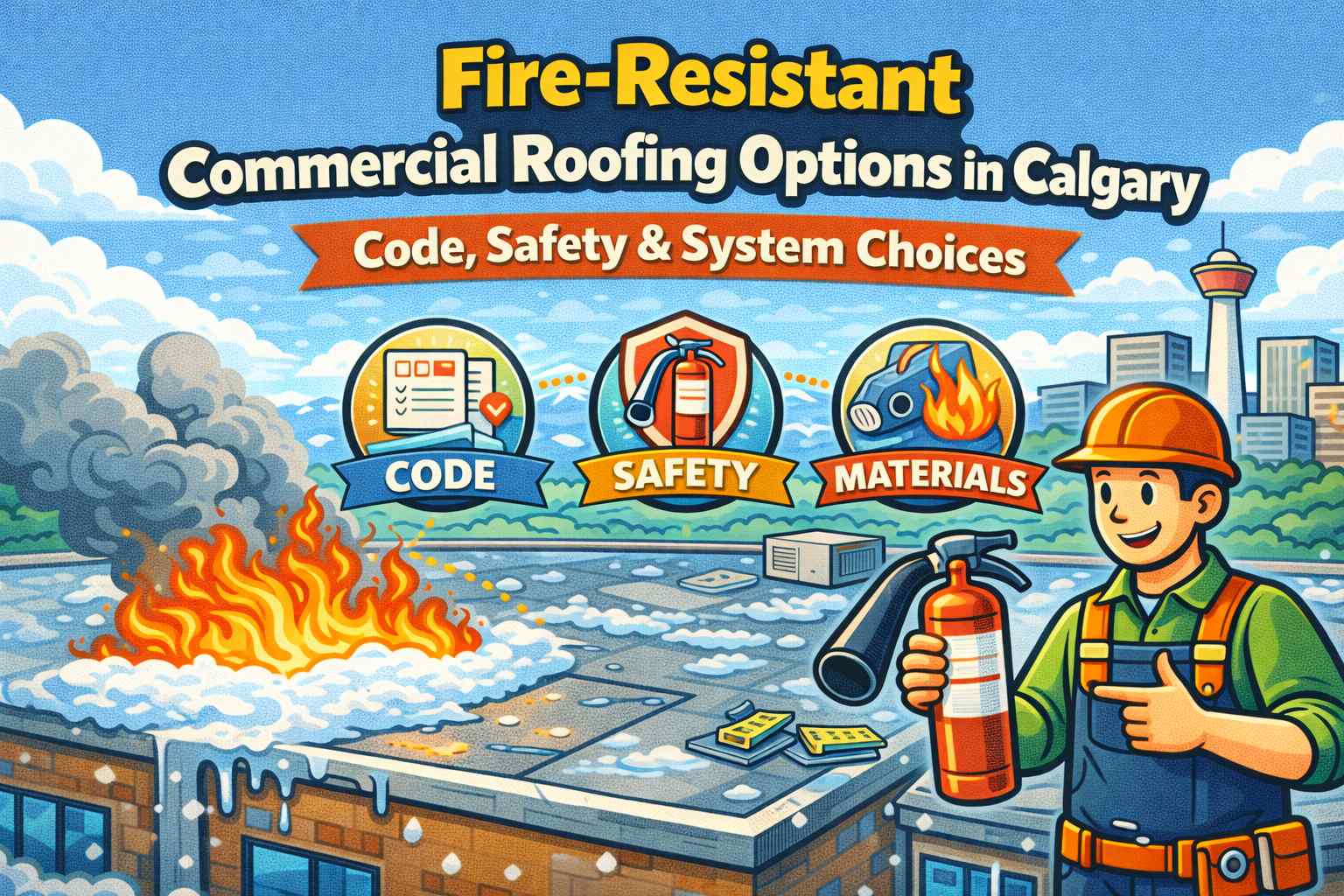
On most projects, fire ratings live in the spec sheet and code review. But if a fire ever starts on or near your building, the performance of your commercial flat roof becomes very real, very fast.
In Calgary, rooftop mechanical equipment, restaurants with kitchen exhausts, industrial processes, nearby buildings, and even wildland-urban interface in some areas all create fire exposure. Add in aging roofs, hail damage, and rooftop work from multiple trades, and you’ve got real risk at the roof line.
This guide explains how fire resistance factors into commercial flat roofing in Calgary—how code and ratings work at a high level, what different systems bring to the table, and how inspections, maintenance, and long-term planning all tie together.
For a full overview of CMP Roofing’s commercial and industrial roofing services, visit:
Commercial Roofing Services
and for related education pieces, use the blog hub at:
Blog
Fire risk on flat roofs doesn’t just come from dramatic events like wildfires. More often, it’s from:
A fire-resistant roof assembly is designed to:
In Calgary’s climate, the same conditions that challenge roof performance—hail, UV, freeze–thaw—also test how well fire-rated assemblies hold up over time. That’s why system choice, detailing, inspections, and maintenance all matter, not just the rating on day one.
For a climate-focused overview, see:
“How Calgary’s Weather (Hail, Chinooks & Freeze–Thaw) Impacts Flat Roof Systems” at Blog
Every building and project is different, and your design team and authority having jurisdiction (AHJ) are ultimately responsible for code compliance. But owners and property managers should understand a few basics.
Roof coverings are often rated for external fire exposure (for example, classifications like Class A/B/C in many standards). A higher rating generally means:
The actual applicable classification and test standards depend on building type, occupancy, and local code interpretation. On many commercial and industrial projects, the goal is to pair:
Fire performance is about the entire assembly, not just the top layer:
Manufacturers test and list specific assemblies. When CMP Roofing designs or installs a system, we work within those tested assemblies and your design team’s requirements.
For broader system selection (performance, not just fire), see:
“TPO vs SBS vs EPDM in Calgary’s Climate: Choosing the Right Commercial Roofing System” at Blog
Each major flat roofing system type has different fire-resistance characteristics—especially when matched to the right deck, insulation, and attachment.
TPO is common on:
In a fire context:
For how TPO fits into Calgary’s industrial and big-box market, see:
“TPO Roofing Calgary: Best Commercial Flat Roof System for Big-Box & Industrial Buildings” at Blog
SBS and traditional BUR (tar-and-gravel) systems have long track records in fire-exposed environments:
On aging BUR roofs, upgrading to SBS can be a chance to build a more fire-resilient assembly while addressing end-of-life issues. See:
“SBS Modified Bitumen Roofing in Calgary: When It’s the Right Solution for Aging BUR Roofs” at Blog
EPDM is a flexible single-ply used on some commercial and institutional buildings:
For where EPDM fits in Calgary projects generally, see:
“EPDM Roofing for Commercial Buildings in Calgary: Pros, Cons & Ideal Use Cases” at Blog
Coatings (silicone, acrylic, polyurethane) are often used to:
From a fire standpoint:
For a detailed comparison of coating types and when they make sense, see:
“Commercial Roof Coatings in Calgary: Silicone vs Acrylic vs Polyurethane Compared” at Blog
On metal roofs:
For more on metal roofs and retrofit strategies, see:
“Commercial Metal Roof Repair & Retrofit in Calgary: Stop Leaks Without Full Replacement” at Blog
A roof might have been properly fire-rated at installation, but Calgary’s climate can:
All of this can undermine the practical fire performance of the roof.
Aging, hail-damaged, or poorly maintained roofs are more vulnerable not only to leaks, but also to fire spread and rapid failure at penetrations or weak spots.
For weather and impact-related issues, see:
“How Calgary’s Weather (Hail, Chinooks & Freeze–Thaw) Impacts Flat Roof Systems”
“Hail Damage to Commercial Roofs in Calgary: Inspection, Insurance Claims & Repair Options”
both at Blog
While specific code design is handled by architects and engineers, a few practical design principles help roofs perform better under fire exposure:
For broader new construction design guidance, see:
“New Construction Flat Roofing in Calgary: Design Considerations for Long-Term Performance” at Blog
A roof’s real-world fire performance depends heavily on its condition.
Regular inspections and maintenance help:
Key resources:
all at Blog
CMP Roofing can build inspection and maintenance programs that support not just leak prevention, but overall roof resilience—including fire safety—outlined at Commercial Roofing Services.
Fires don’t always fully burn through the roof, but they can:
After any roof-related fire or rooftop incident, it’s critical to:
For leak and emergency-response process details, see:
at Blog
CMP Roofing’s emergency response and repair services are described at:
Commercial Roofing Services
Some roofs, especially those:
may no longer be good candidates for long-term restoration.
At that point, full replacement with a modern, fire-resilient, code-compliant assembly is often the most responsible move for both safety and lifecycle cost.
For guidance on deciding between coatings, overlays, or full tear-off, see:
“Commercial Roof Replacement vs Restoration in Calgary: Coatings, Overlays or Tear-Off?”
“End-of-Life Signs for Commercial Flat Roofs in Calgary: When It’s Time to Replace”
And for multi-building owners, integrate these decisions into your broader portfolio planning using:
“Roof Asset Management for Calgary Property Portfolios: Budgeting, Lifecycle & Risk Planning” at Blog
CMP Roofing works with owners, property managers, condo/strata boards, and developers across Calgary and surrounding areas to:
Service overview: Commercial Roofing Services
Service areas: Service areas
Education hub: Blog
If you’re planning a new roofing project—or you’re not confident how your current roof would perform under a fire exposure—the best next step is a commercial roof assessment with fire and safety in mind.
CMP Roofing can:
To discuss a specific building or portfolio, contact CMP Roofing via:
Contact
Confirm that your building falls within our service area at:
Service areas
And for more detail on system choice, weather, inspections, maintenance, drainage, restoration vs replacement, and asset management, continue exploring the CMP Roofing blog at:
Blog and our Commercial Roofing Services hub at Commercial Roofing Services.

Comments are closed here.